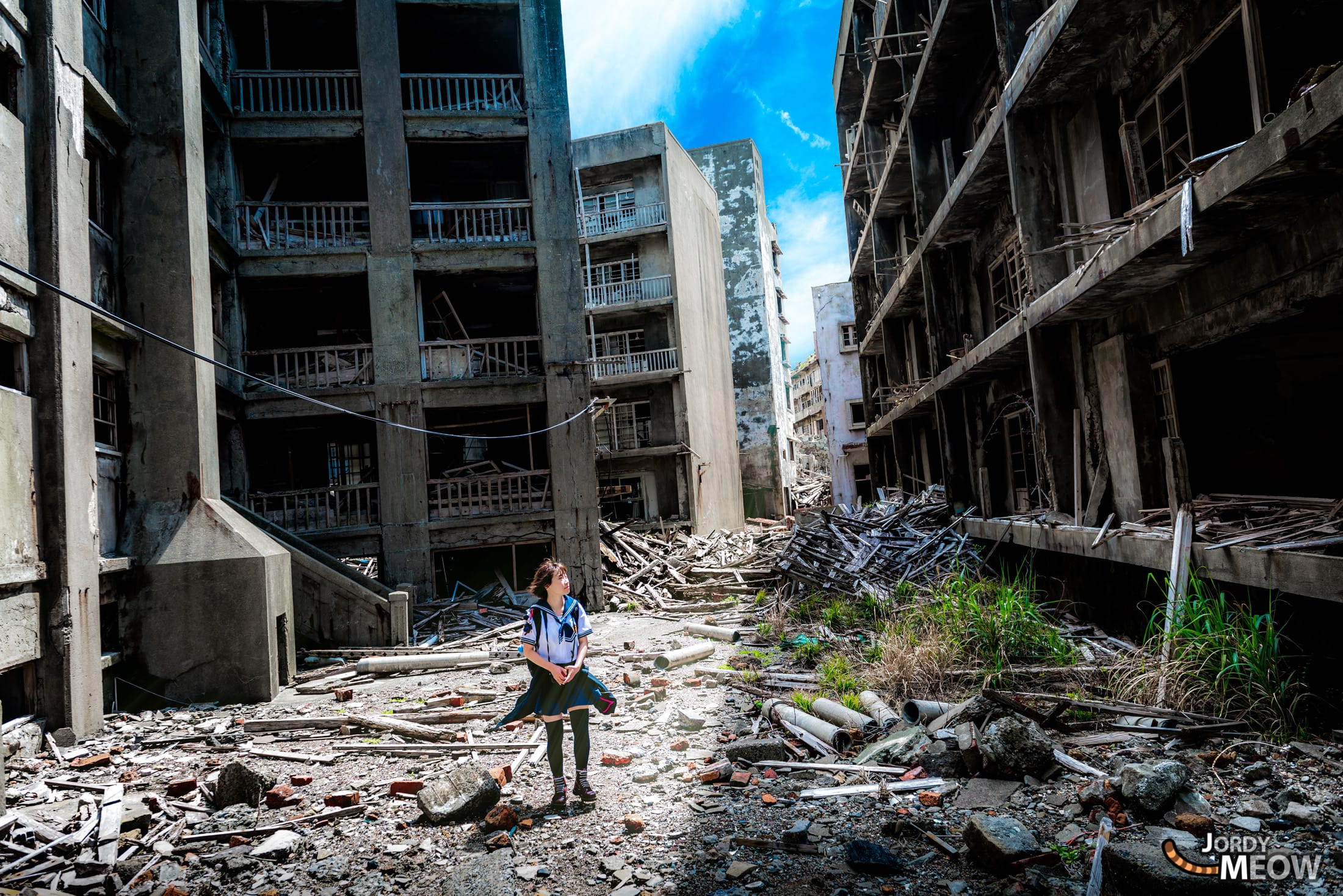
The ghost island of Hashima: Gunkanjima. The Queen of the Ruins of Japan. I didn’t expect to go there so soon, but the past weekends had been so wild and rich in adventures that I absolutely needed this fabulous checkpoint to close out 2010 in style. So let’s set off to discover Gunkanjima and its history.
Since this article was published in 2010, I’ve had the chance to return to the island four times, take much better photos and write more stories. You’ll find my summary here: Gunkanjima: Stories & Photos.

1810.
A coal seam was discovered on Hashima Island, a tiny island a few kilometers off Nagasaki.

1890.
The island was bought by Mitsubishi, who launched its real exploitation. The company installed the necessary infrastructure and brought in workers along with their families. Many perished from malnutrition, karoshi (death from overwork), illness or accidents in the mine… and quite a few chose to throw themselves out of the windows to end this miserable life faster. A true fortress of hell. The nuclear bomb on Nagasaki in 1945 didn’t help: the windows of Hashima Island all blew out, but the workers had to keep going. Japan had to be rebuilt.

1959.
Hashima Island became a true megalopolis: 5,300 inhabitants (84,100 inhabitants/km²!), at that moment the highest population density in the world. The land was completely urbanized: housing of course, but also two schools, a hospital, a gymnasium, a movie theater, 25 shops, a temple, a pachinko, several bars and even… a brothel. The whole thing plunged into the darkness of a labyrinth of stairs and corridors. Hashima Island produced a very high quality coal, which helped Japan sustain its economic growth.

1974.
Oil came to completely replace coal, and the mine announced its closure. On April 20th, the last inhabitant left the island. Hashima Island then became the famous ghost island of Gunkanjima.

2010.
We arrive at Gunkanjima on a beautiful autumn day. Hashima Island or Gunkanjima: why two names? Gunkanjima means “The Battleship Island”. It’s an unofficial name, but far more used than the official one, because of the island’s strong resemblance to… a cruiser. A small concrete chapel sits at the top of the island. Beside it once stood the only wooden house on the island: the residence of the boss.

Since it was abandoned, the island has been off-limits. Only a few fishermen have been granted permission to settle around it to fish in peace. Sometimes, derogations are given to journalists or film crews… but every now and then, curious souls also go there without asking. Anyway, I’m not on the island yet. Just on a boat that offered us a small tour around it. After that little tour though, we’d find a way to get on the island! Arranged for the next morning, at the crack of dawn.

NOVEMBER 19th. 6:00.
We board the little boat. Once we’re a way off the coast, all the boat’s lights are cut. The reason? To go unnoticed. Excitement rises. And we can already make out Gunkanjima in the half-light.

The captain orders us to jump quickly onto the island from the bow of the boat. He’ll be back in exactly one hour, and we’ll have to wait for him, hidden behind the concrete wall. We’re on the island at last. It’s truly dark, and taking photos will be difficult. The plan is to make a full loop of the island, which should be easy: according to a former miner, crossing the island barely takes the time of a cigarette to burn down.

Moving around isn’t easy. Many buildings have collapsed, and the ground is covered with pieces of wood, scrap iron and shapeless objects. You have to be very vigilant. We push quickly past the apartment zone to head over to the mine side. The residential area is the most interesting, but it’s better to leave it for the end. The light should be better.


There’s not much left of the mine itself. It was probably destroyed by Mitsubishi when the island was abandoned.

The public baths of Gunkanjima used to be here. They were probably surrounded by walls before, but now they look straight out onto the Nagasaki coast. Further down is the new Observation Deck where official tourists can now go (since April 2009).

Back into the residential zone. The place is unreal. It feels like being dropped into the movie Metropolis. A true labyrinth where you let yourself get carried away through the maze of passageways, alleys and staircases…
I’d love to take the time to visit each building, each room, set up my tripod and make beautiful shots… but every glance at the running clock is like a taser jolt: there is no time. The truth is, it’s also very easy to get lost. Moving from one place to another is far from straightforward, not just because of the debris but because the city’s configuration is unlike anything else. And our only chance to make it back to the mainland without trouble is that boat… which is coming in only half an hour.

By taking steep passages, we end up at the top of one building. We have to get back down, and the clock is still ticking, so we’ll need a shorter route. Those stairs over there look rickety but seem to be the only solution.

The inhabitants of Gunkanjima had three months to clear out in 1974. As a result, very few objects remain… Here, a vintage television (or is it a video game?).

From your balcony, hundreds of neighbors are within spying distance! A paradise for voyeurs, a nightmare for everyone else.

The streets are full of debris. We’re not exactly safe here, but I reassure myself: it’s a very calm day, and Gunkanjima has weathered countless typhoons, tsunamis and even an atomic bomb, so come on, surely nothing is going to happen now!

The Stairway to Hell (地獄段) is in fact the access stairway to the small temple at the top of the island. It’s not for nothing that the climb is so brutal it feels… infernal!

The buildings in this photo all date from 1918, and were the main residential blocks on the island until they were dethroned, a bit later, by the famous Block 65.

Gunkanjima’s architecture is fascinating: most of the buildings are connected to each other by footbridges. A futuristic vision, yet a gloomy one.

The Block 65 (65棟) is by far the most impressive building on Gunkanjima, and on its own makes this unofficial tour worthwhile. Built in 1945, it stands 9 stories tall and contains 317 apartments. The grass in the middle wasn’t there originally. Gunkanjima was famous for having no vegetation at all, which gave its name to a movie filmed here: Midori Naki Shima (緑なき島, The Greenless Island) in 1948.

A phantasmagorical Totoro that feeds the most troubling myths of 21st-century Japan rules over this place. Beware of this infamous creature. And don’t stare at this photo too long, it might burn out your eyes.

The Block 65 looks like a cemetery of haunted houses, wedged into one another…

A forgotten poem on a wall (so simple and raw I’m not sure it really is one), which I’ll do my best to translate:
Decades have gone by,
Time has rusted and gangrened it.
This island is now rotten,
Never again will it return to life.

From the hospital, you have a direct view onto the playground of the school nearby. Ah, youth. The good old days. Innocence. Health. Happiness. Everything seemed so easy.

The operating room of the hospital. I take this moment to leave a geocache on the chair in the back. Will anyone else ever sign it?

The Block 65 (on the right) is actually very close to the high school (behind, on the left).

A crescent moon traces itself between the buildings…

The photo on the left shows an end-of-year ceremony. There already weren’t many people left.

Welcome to Gunkanjima high school! It’s actually a fairly recent building: it dates from 1958, and was the last one built on the island (apart from a small annex behind it).

In the past, the place must have been so noisy and full of life. The buzz of daily breaks in the playground, carried by the heavy, ceaseless noise of the mine; the “city center” and its little shops just nearby… Now, only the sound of the wind slipping between the buildings disturbs the silence.

The inside of the high school is rather sad. This is only the second floor, so maybe there are more surprises in the upper floors, but I doubt it. I’m counting the minutes now, and I can’t allow myself to climb any higher.

We decide to head back to the agreed-upon spot to re-board the boat. We can already see it in the distance, returning. I have maybe 2 or 3 minutes left…

One last picture as the sun rises and lights up the Block 65. The ocean is more lively now, and there are boats appearing everywhere (fishermen and others). In short: this is getting risky. 7:30 in the morning. Time to go.
This little mosaic seems to say “Thank you for visiting Gunkanjima. Looking forward to seeing you again soon!” Well… we shall see!

The boat bumps gently against the wall and, without hesitation, we jump aboard. Quick and clean. Immediately, the boat throttles up. We have to leave, fast. The captain gets a strange call from the coast guard. We hide as best we can, fairly worried. But in the end, we make it back safe and sound, and the arrival is full of joy. Even the captain is suddenly cheerful and talkative for the first time! An unforgettable moment. We did it!

For more information about the geocache I left on Gunkanjima, head over here: GC2JX0Q! For those wondering, geocaching is an activity that consists of seeking out or hiding caches containing a small register of the visits. I’m proud to have placed the very first one here. As for the old black and white photos, they’re all by Yuji Saiga. They were taken in 1974, during the last three months of the island’s activity. Go have a look at his website, it’s brilliant.
If you enjoyed this article, don’t miss my summary of the island: Gunkanjima.


 Instagram


