
On the shores of Lake Biwa, an hour from Kyoto, Omihachiman is a rare pearl where time seems suspended. Far from the bustle of classic tourist circuits, this town offers deep immersion in traditional Japan, between alleys lined with merchant houses, Shinto shrines, and ancestral rituals.


Omihachiman is a timeless stop where traditional Japan unfolds all its charm. A formerly prosperous merchant city, it became, from the feudal era, a major commercial crossroads thanks to its canals and waterfront warehouses. The wealthy merchants of Omihachiman never hesitated to brave the storm to sell their goods across Japan, and the city prospered over the centuries as a vibrant centre of trade and culture.


Today, Omihachiman retains that timeless atmosphere. The narrow alleys with their wooden houses evoke a past where samurai crossed paths on horseback, monks recited sutras at dawn, and merchants counted their fortune by lantern light. Far from the Kyoto crowds, you discover a more discreet Japan, where the inhabitants still take time to greet every passerby, and where ancient festivals are celebrated with contagious enthusiasm (and sometimes a little sake for the road!).
🏘️ An atmosphere frozen in time


Wandering the streets of Omihachiman is like travelling back to the Edo era. The city has preserved its old-world charm, with its quiet alleys lined with machiya featuring dark wooden facades and lattice windows. The Shinmachi-dōri quarter, in particular, is a remarkable example of conservation, offering immersion in traditional Japanese architecture. This unique atmosphere is reinforced by cultural initiatives such as the Biwako Biennale, a biennial art event that takes over the city’s historic buildings for contemporary exhibitions. This festival contributes to preserving the architectural heritage while breathing new life into these ancient structures. Omihachiman thus offers an authentic and peaceful experience, far from the bustle of the big cities.


The Chinowa Ritual: a virtuous circle of purification
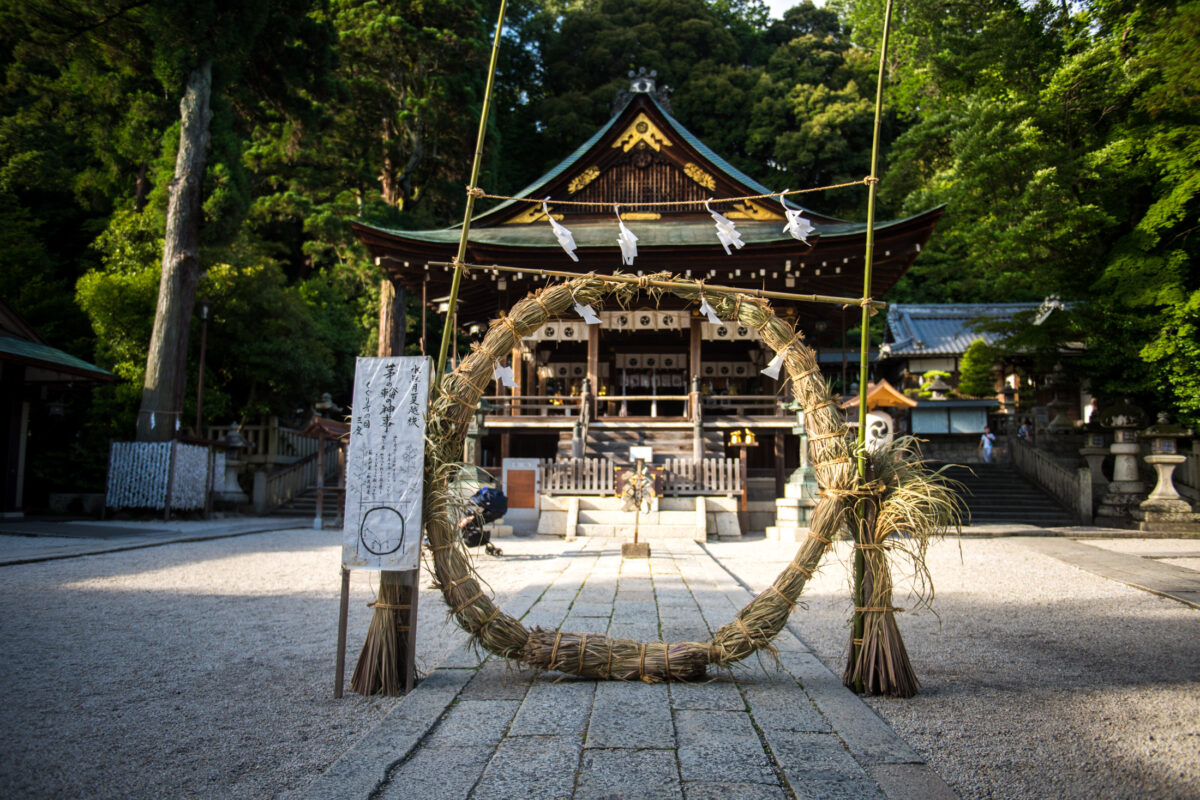
At the Himure Hachimangū shrine, a Shinto ritual draws crowds at the end of June: the passage through a large circle woven from plants, called chinowa. This ritual is intimately linked to the Nagoshi no Harae ceremony, the mid-year purification practised throughout Japan to shed impurities accumulated during the first six months of the year. According to legend, this ritual originates from a man named Somin Shorai, who offered hospitality to the storm kami Susanoo disguised as a beggar, and received in exchange a ring of woven grass said to protect him from epidemics.
On June 30, most shrines in the country, even the most discreet ones, install a large ring of dried grasses (the chinowa) for this ceremony. The practice, called chinowa kuguri, consists of passing through this ring according to a precise and codified path:
- You bow in front of the circle, then cross it with your left foot and go around to the left.
- Then, you bow again, cross with your right foot, and go around to the right.
- Another bow, cross with your left foot, and go around to the left.
- Finally, one last bow, cross with your left foot, and continue straight ahead.
This figure-of-eight movement symbolises purification from harmful influences and the invocation of blessings for the months to come. While it might seem complex, the gesture is simple and powerful: it cleanses the spirit on the eve of the great summer heat, in preparation for the O-Bon festival, when the souls of ancestors return to share a moment with the living. Once you’ve passed through the chinowa, you are symbolically purified, ready to pray at the shrine’s main building.
This ritual is at once humble and universal: it takes place in small countryside shrines as well as in large urban ones. At Omihachiman, the chinowa at Himure Hachimangū invites everyone to feel this deep connection between nature, ancient legends, and the serenity of the present.

Hachiman-bori: a walk along the water 🚣

The Hachiman-bori canal, a vestige of the city’s merchant past, invites a peaceful boat ride. Lined with traditional houses, it offers an idyllic panorama, especially in spring when the flowers are in full bloom. Once a major commercial artery, this canal was threatened with filling-in during the 1960s, but the people of Omihachiman, proud of their heritage, rolled up their sleeves to restore it stone by stone. Today, sailing on its waters is like travelling back in time: you encounter the reflections of old warehouses, the silhouettes of vanished merchant boats, and, with a little imagination, perhaps even a samurai out for a stroll along the banks.


Omihachiman is not just a postcard backdrop: it’s a place where the past still vibrates, where every stone seems to tell a story. Whether you’re a history enthusiast, a lover of rituals, or simply curious to discover a more discreet Japan, this town will surprise you and touch you right in the heart.


Same corner of Japan, quieter still: Kongorin-ji and its army of Jizo, and over in Kyoto, Otagi Nenbutsu-ji and its 1,200 faces.


 Instagram


