
Naoshima is a small Japanese island in the Seto Inland Sea, between Okayama and Kagawa prefectures. You reach it easily by ferry from Uno or Takamatsu. Arriving, you might think of a banal port, a discreet village, a wooded hill like so many others. And yet, here, sculptures grow like mushrooms, the cats seem to pose for visitors, and works of art surge up in the most unexpected places: a fisherman’s house, an old hair salon, a corner of beach. Naoshima has become, in a few decades, one of the most fascinating islands of Japan, an improbable playground.


From a factory island to a laboratory of utopias
At the start of the 20th century, Naoshima lived to the rhythm of a copper refinery. The installation of Mitsubishi, in 1918, radically transformed the landscape. Burned trees, levelled hills, air saturated with smoke. Then, in the 1990s, an art-passionate businessman, Fukutake Soichiro, imagined a crazy project: to breathe life back into the island through culture. He began by restoring old houses in Honmura to turn them into exhibition spaces: this was the birth of the Art House Project. He then entrusted architect Tadao Ando with the construction of museums like the Chichu Art Museum, buried underground so as not to disturb the landscape, where natural light modulates the experience of Monet’s Water Lilies. Today, Naoshima is an ecosystem where architecture, nature, inhabitants, and works coexist in a sometimes shaky but always intriguing balance.


Two pumpkins, two moods
Naoshima’s icon is a pumpkin. Yellow, monumental, dotted with black spots. Set alone at the end of a jetty, it seems to watch the ferries nonchalantly. Created by Yayoi Kusama, it has become more than a work: a totem. In 2021, it was swept away by a typhoon, and its absence created a real void. It returned, repaired, almost as before. But since then, it seems even more precious, as if it had survived a trial.


What’s less said is that there’s another pumpkin. Red, this one. Less contemplative, more playful. Installed near the port, it has holes, passages, openings: a sculpture you enter, crawl into, disappear into. Children love it. Adults too, even if they pretend they’re only going in to accompany the children. Kusama slipped a piece of childhood into it, of joyful madness, and that sums up the island fairly well.


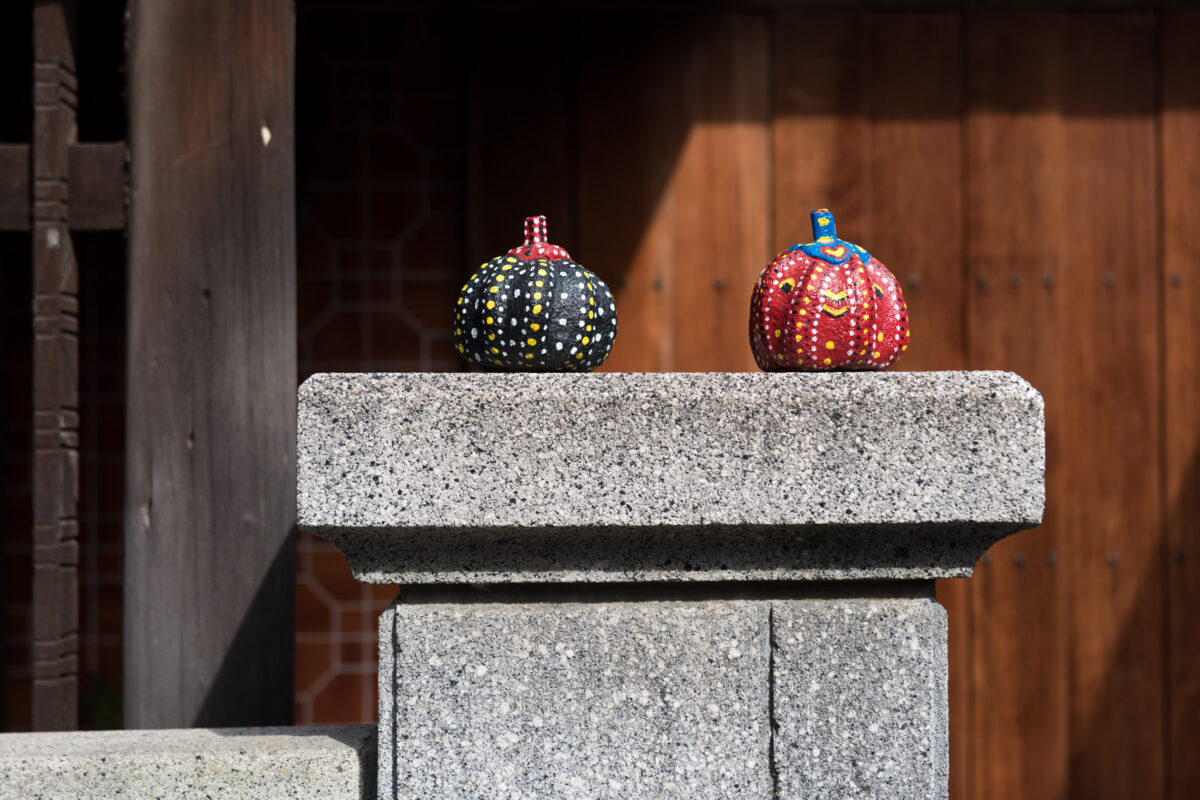
I also came across two small pumpkins set on a low wall. Nothing official, no plaque, just there, hand-painted. Probably a wink from someone local. That’s also Naoshima: between two signed works, people appropriating the atmosphere in their own way.

Hidden works and free-roaming cats


Outside the marked museums, there’s everything else. Works scattered in the corners of the island. Stainless steel sculptures placed near a bench. Multicoloured installations rising from a vacant lot. One day, I came across a feline structure, kitschy in its own confident way but perfectly uplifting. A pop work that almost overshadowed the island’s cats! Everywhere. Indifferent, elegant, sometimes familiar. One of them followed me for several hundred metres before going back to lie down, as if nothing had happened, under a sign reading “no photography.” I duly complied.


Walking a little at random, you can cross paths with a giant rubbish bin, all colours, obviously not made for trash. Or an old suspended bicycle, fully customised, like escaped from a child’s dream. And then there are the works of the brilliant Niki de Saint Phalle: a mosaic bench, with a reading figure placed there as if it were nothing, and those big intertwined snakes, full of joy and raw energy. At Naoshima, art spills out almost everywhere, often without warning, and that’s what makes it so alive.


And then there’s everything not classified as contemporary art but which deserves the detour just as much: half-erased retro storefronts, wobbly architecture that might have stepped out of a 60s film, abandoned shops filled with forgotten trinkets.


Wandering without an objective, you stumble into a gently off-kilter Japan, a little out of time, that contrasts deliciously with the polished minimalism of the museums.


A sweet pause and a real misstep
I must tell you about Kokochi. A small café installed in an improbable Japanese house, halfway between the elegance of an Edo ryokan and the clutter of a Showa parlour. The interior is a festival of knick-knacks, but the desserts… what a slap. Melting macarons, meticulous plating, perfect textures, all done à la minute. It’s not a café, it’s a sweet ceremony.


Conversely, I tested Naoshima Noodles. Bad move. The place looks like a garage converted into a canteen, and despite the rave reviews, I got a fuzzy, sweet, lukewarm, and sad bowl of ramen. A misstep in an otherwise flawless setting.
Naoshima, by feel
What you should know is that Naoshima is better experienced when you accept not to plan everything. The island isn’t there to rush from spot to spot. You have to walk, hang around, sit, get lost. Watch the sun on Ando’s concrete walls. Follow a cat to a dead end. Take a bike and head off without a destination. And if you go as far as Tsutsuji-so beach, you’ll find a small onsen facing the sea. The water is hot, the view perfectly clear, and after a day of wandering between art, cats, and alleys, it’s probably the best way to no longer want to leave.


And if you have the luck to linger on the island, perhaps, like me, you’ll have this rare impression: of having stepped somewhere between a waking dream and an artistic vacant lot. A calm place, but gently hallucinated. On a soft acid, then. Just enough.

The other Setouchi islands: Ogijima, the crooked island, and Megijima, where the demons have retired.


 Instagram


