
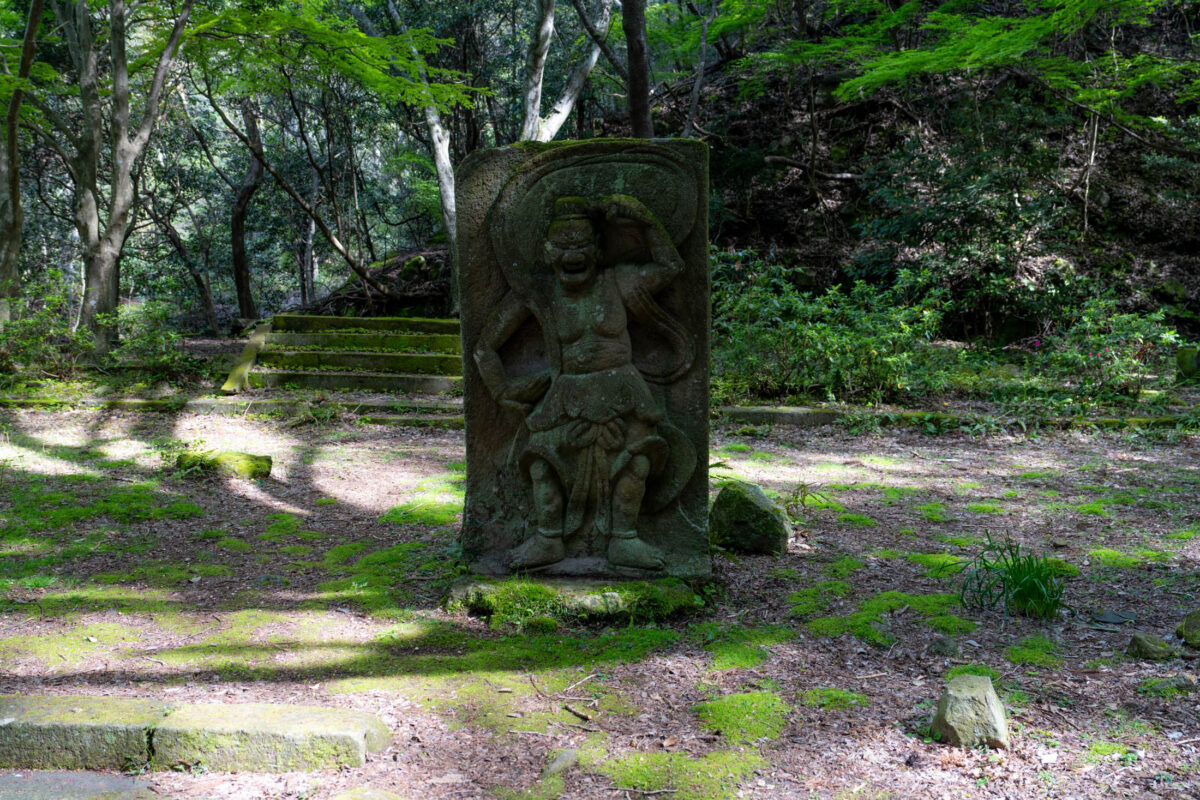
On a mountainside, hidden by vegetation, the remains of a temple endure: Kyu-Sento-ji. Once a major place of worship, it blended Buddhist and Shinto influences, bearing witness to the religious syncretism unique to the Kunisaki Peninsula. Today, Nio statues still watch over this forgotten site, where torii and Buddhist relics coexist in an atmosphere out of time. What remains of this vanished temple?
Legendary Origins

According to tradition, in 718, the legendary monk Ninmon is said to have founded Sento-ji along with 27 other temples in the region. Although records from that time are scarce, the presence of Ninmon’s tomb and the cave where he is said to have died, located higher up the mountain near the Okunoin, reinforce this legend.
Destruction and Renaissance


Over the centuries, Kyu-Sento-ji has passed through tumultuous periods. It was largely destroyed around 1560 during the clashes between Otomo Sorin and the armed monks of Usa Hachimangu. Despite this, the site retained activity until a forest fire in 1968 destroyed the last remaining structures. Following this tragedy, a new Sento-ji temple was built lower down, offering a place of worship to the faithful while preserving the memory of the original site.
A Crossroads of Beliefs


The Rokugo Manzan region is known for its syncretic religious culture, blending Tendai Buddhism, the cult of Hachiman, and ancient mountain practices. This fusion is particularly visible at Kyu-Sento-ji, where elements such as Shinto torii and Buddhist statues coexist harmoniously, reflecting a rich history of tolerance and spiritual integration.
An Immersive Experience
Walking the paths of Kyu-Sento-ji, you are surrounded by the serenity of nature and historical remains. The imposing stone walls and paved paths lead through landscapes where nature has taken back its rights, offering a unique meditative experience. Each spring, the site dresses itself in a carpet of white irises, symbolizing rebirth and the continuity of life.


A Living Heritage
Although the original structures of Kyu-Sento-ji are no longer standing, the spirit of the place lives on. Visitors can feel the presence of past generations and contemplate the resilience of Japanese faith and culture. Kyu-Sento-ji is not just a historical site but a living testimony to how traditions and beliefs can evolve while honoring their roots.


Oita keeps a few more secrets: the heavenly carpet of Yabakei, Shishi Gongen, the sanctuary of skulls, and the millennial tree of Momiyama Shrine. Further north, another place of worship left to the forest: the forgotten church of Mount Fuji.

 Instagram


