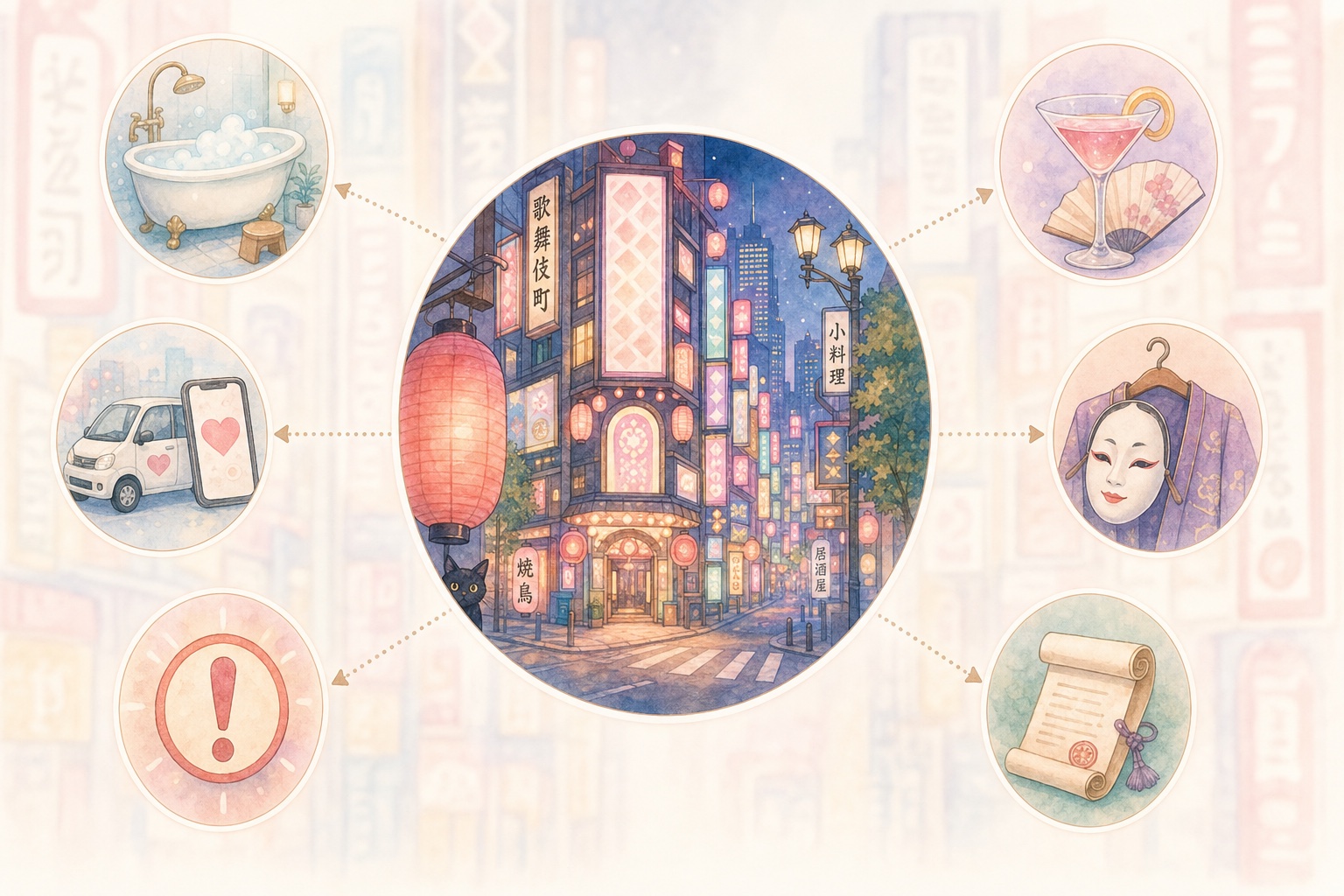
Japan is home to one of the largest and best organized sex industries in the world, and yet almost all of it is, on paper, perfectly legal. How is that possible, and more importantly, what really goes on behind each kind of storefront? Here is the honest panorama, venue by venue, with the figures and testimonies to back it up, and every time the reason why, after almost twenty years here, I don’t recommend it. If you want to understand the culture and the laws first, start instead with my guide to sex in Japan.
The law, or why everything is “except that”
The 1956 anti-prostitution law punishes only one precise act, paid vaginal intercourse with an “unspecified” person. Everything else is therefore negotiable. The fuzoku grew up in that gap, offering absolutely everything except the forbidden act, under license from a second law that regulates businesses “affecting public morals.” That law sorts this whole world into two families, on one side the pure-companionship venues where contact is forbidden, the hostess and host clubs, on the other the establishments of a sexual nature, soaplands, health, deriheru. Hence the multitude of formats that follow, each one a different way of working around the same sentence of law. At the end of 2024, the national police counted 33,890 registered, including nearly 23,000 delivery services and around 1,200 soaplands.
Hostess clubs (kyabakura)
Let’s start with the least scandalous. A kyabakura is not a brothel, it’s a club where hostesses sit at your table, pour the drinks, light the cigarettes, flatter and sing. Physical contact is strictly forbidden. In Ginza the clubs are chic and outrageously expensive, elsewhere it’s more relaxed.
The real trap here is the bill. The “set” advertised at 5,000 yen an hour is only the beginning. On top of it come a table charge, a “shimei” of 1,000 to 4,000 yen if you request a specific hostess rather than the rotation every twenty minutes, the price of your drinks and of the ones she drinks, and 15 to 20 percent service. A bottle of champagne triggers a “champagne call,” the whole club sings around your table, and a simple Veuve Clicquot costs you 20,000 to 25,000 yen. A “5,000 yen set” thus very quickly becomes a 30,000 yen bill. The reflex that saves you, say at the door that it’s your first time, and they will explain the whole system to you in detail.
A former hostess, who worked seven years between Tokyo and Osaka, described her job in a long AMA on Reddit. Her account of the kyabakura is crystal clear.
Pretty young girls, very dressy gowns, a high-energy atmosphere. You pay by the hour, and depending on the place, they’ll always try to get you to open a bottle of champagne.
She also said she got into the job to pay for her dog’s surgery, a useful reminder that behind every paid smile there is often a story of money and need.
As a cultural curiosity, once, why not. But you spend a fortune for scripted affection, the hostess is paid to find you charming, that’s her job. As a way to meet someone, it’s a paid mirage.
Host clubs and the debt trap
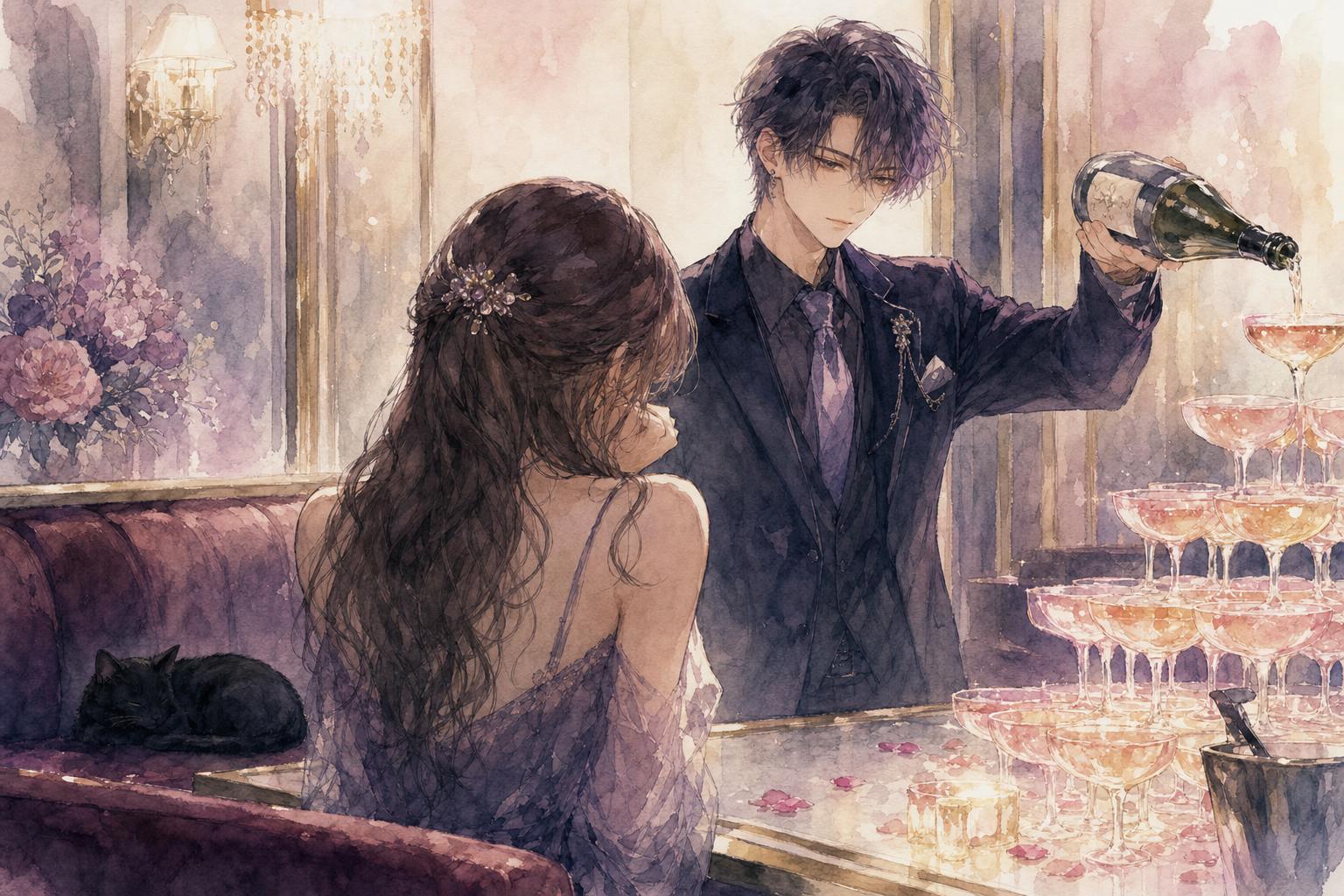
The exact counterpart of the kyabakura for a female clientele, with young men in suits, styled like manga characters, who pour the drinks and whisper promises. Here too there is no contact, you pay for the company. But the host club has spawned one of the darkest social scandals of recent Japan. In Kabukichō, their number exploded, going from around sixty in 2020 to more than 300, and the competition has made the methods ruthless. The mechanism is called urikake, the running tab on credit. A host runs up a customer’s bill, rounds of champagne worth several hundred thousand yen, swears exclusive love to her, this is irokoi, and when the debt reaches millions, she is “suggested” to go pay it off in a soapland or in deriheru. The amounts are staggering, one young woman admitted she sank 48 million yen on a single host over three years.
The scale of it finally forced the state to react. In 2024, the police received 2,776 consultations about host clubs and arrested 207 people. And on May 20, 2025, the Diet passed a reform of the entertainment business law, in force since June 28, 2025, that now bans pushing an indebted customer toward prostitution, bans the commissions paid by sex establishments to “recruit” these women, and raises the penalties to up to five years in prison and a ten million yen fine. Buying on credit is not banned in itself, but its predatory version becomes unworkable.
For a visitor, the host club is mostly expensive and confusing. But above all, it’s the machine that, behind the scenes, pushes very young women into debt and then onto the street. Spending there means feeding that gear. The decor is flashy, what’s behind it much less so.
Soaplands
The most explicit format, and the most emblematic of the system. In a soapland, you pay an entrance fee to “use the baths,” then a “massage.” It’s during this moment that the worker and the client “get to know each other,” which legally takes what follows outside the definition of prostitution. This is called the fiction of jiyū ren’ai, free love, and everyone has gone along with it since the 1960s, even though the Supreme Court swept it aside back in 1986, a manager does not need to “know” what is going on to be held responsible. The fiction holds up in practice, much less so in law. The Yoshiwara district, the old pleasure quarter of the Edo period, holds the most famous of them, around a hundred today out of the country’s roughly 1,200 to 1,400. In Osaka, the Tobita Shinchi district offers another variant, inherited from the old licensed quarters, where the same fiction plays out in mock traditional restaurants rather than in soaplands. The entrance fee runs into the tens of thousands of yen, and the high-end addresses comfortably exceed 60,000. Like the vast majority, they flatly refuse foreigners. The reason given on the business side is actually less about racism than about language, the managers explain that with a client who doesn’t speak Japanese, it becomes almost impossible to convey the very precise limits and prohibitions of the service, and that the slightest misunderstanding can quickly go wrong.
A one-time client described it on Reddit, as fascinated as he was anxious, and his account captures the chillingly efficient side of the machine.
Some soaplands don’t accept foreigners, so I had carefully scouted out an address. I was surprised how smoothly everything went. The employee handed me a ticket and told me to come back in an hour.
The whole thing rests on a slightly absurd legal pirouette, and the door will often be closed to you anyway because you’re a foreigner. Beyond the legal gray area, you’re very far from any real encounter, and the element of exploitation is rarely absent.
This world sometimes ends in ruins, and that may be where it tells its story best. I explored an abandoned soapland, the Queen Chateau, a manor left to the ghosts, and a forgotten strip theater deep in a forest, two haikyo that sometimes say more than any operating venue ever could.
Delivery health (deriheru)
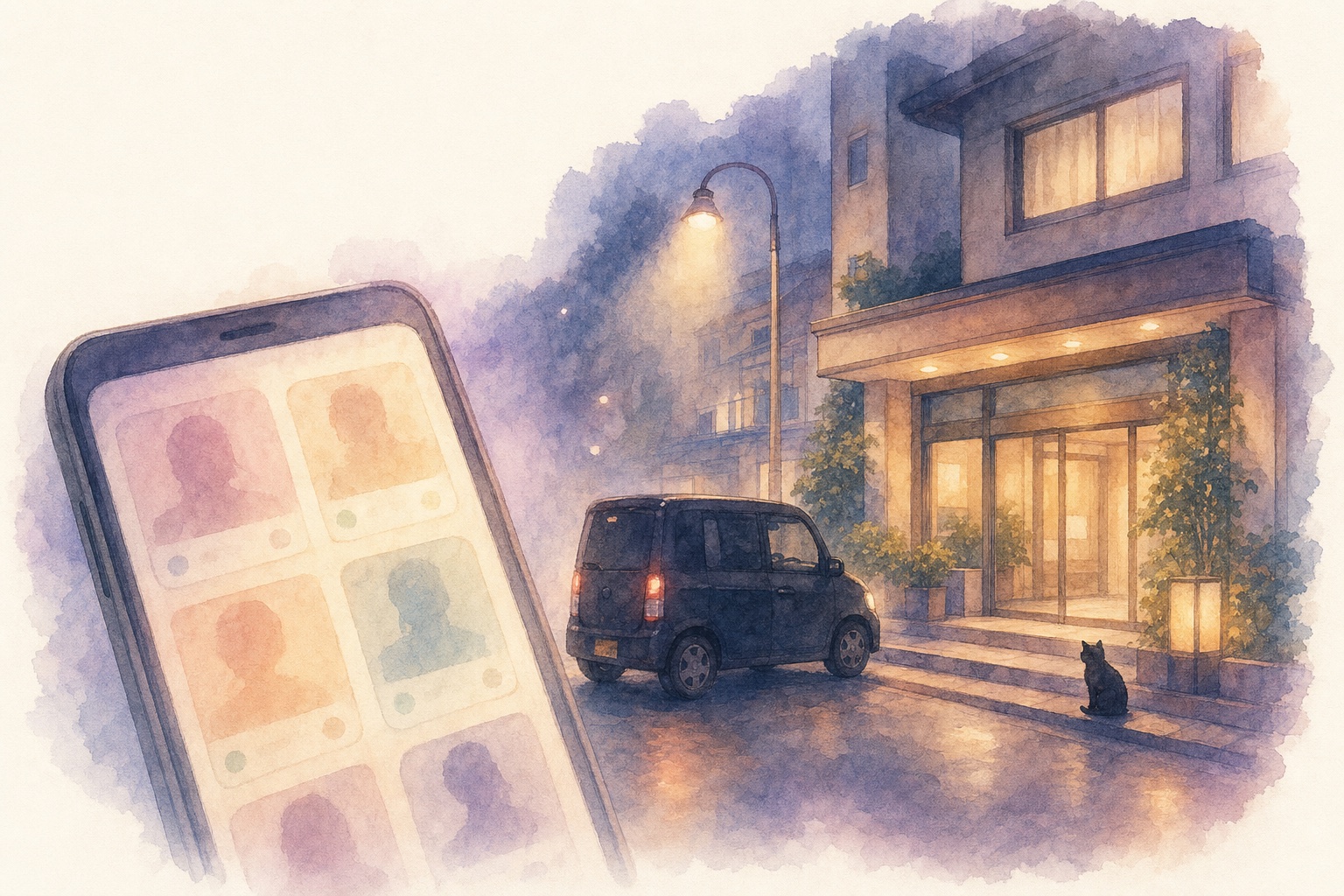
This is today the most widespread form, nearly 23,000 registered services on its own. The deriheru, short for “delivery health,” works without a storefront. You choose profiles on a website with photos, heavily filtered these days, you book by phone, and a woman is delivered to your hotel, a driver often waiting in a car nearby, one you have probably already passed without realizing it. And contrary to what one imagines, nothing is vague. The agency officially charges only a basic “course,” services meant to stop short of the act forbidden by law. But when she arrives, the young woman presents her own menu of “options” without ceremony, and that’s where everything is decided, the most intimate services, up to intercourse, appear as extras paid directly, on top of what the agency has already collected. The legal fiction on one side, a perfectly explicit price list on the other. Many agencies refuse cheap hotels, and many refuse foreigners.
Clients everywhere describe the same two-tier architecture, a modest advertised price announced by the shop, then the real fee paid in cash, on the spot. On a travelers’ forum, a regular sums up the rule for soaplands, which holds for pretty much the whole fuzoku.
You first pay an entrance fee to the shop, then the service in cash, directly to the girl, once you’re in the room. Generally the total comes to twice the entrance price. If the entrance shows 10,000 yen, you actually need more than 30,000 yen in your pocket.
The word says it, health. This isn’t pleasure, it’s care. It exists for people who, for one reason or another, have no access at all to intimacy and yet need it. On the other side, the woman does this all day long, with no desire and not the slightest interest in you. It’s mechanical, about as warm as a blood draw. You meet no one, and you feel nothing real. It’s neither Japan, nor an encounter.
Fashion health and pink salons
Two storefront variants. The fashion health is the equivalent of the deriheru but with a fixed address and private rooms, services always staying short of the forbidden act. The pink salon, or pinsaro, is even more expeditious, a dark bar-like room, drinks, no private rooms, and an essentially oral service. As is so often the case, foreigners are rarely accepted there.
The same transactional logic as the deriheru, only more impersonal still. The atmosphere is cold and rushed, the hygiene uneven, and it’s hard to imagine an experience further from anyone’s idea of a beautiful moment.
Image clubs (imekura)
The image club, or imekura, is built on role-play. Sets recreate a classroom, an office, a train car, and the worker plays a character according to the chosen scenario. The services here too stay mostly oral, so as not to cross the legal line. It’s less about sex than about staging a fantasy.
It’s theater, not an encounter. You pay for a scene and a costume, and the person across from you plays a role, that’s all. There’s something a little sad about paying for a simulation when the real Japan is right outside.
The “free information centers”
In the red-light districts, you’ll see glowing booths everywhere marked “muryō annaisho,” literally free information center. They appeared when street touting, the kyakuhiki, became illegal in most wards. Registered with the police, they steer the client toward a health, a soapland or a deriheru nearby, charge him nothing, and take a commission from the venue, hence the “free.” They are presented as safer than following a tout in the street, but a good magazine or a specialized website is still reputed to be more reliable.
They are tied to several venues in the area, so you can assume a certain reliability. But they are still considered less safe and less cost-effective than a good magazine or a good website.
Ōkubo, the street and the truth no one shows
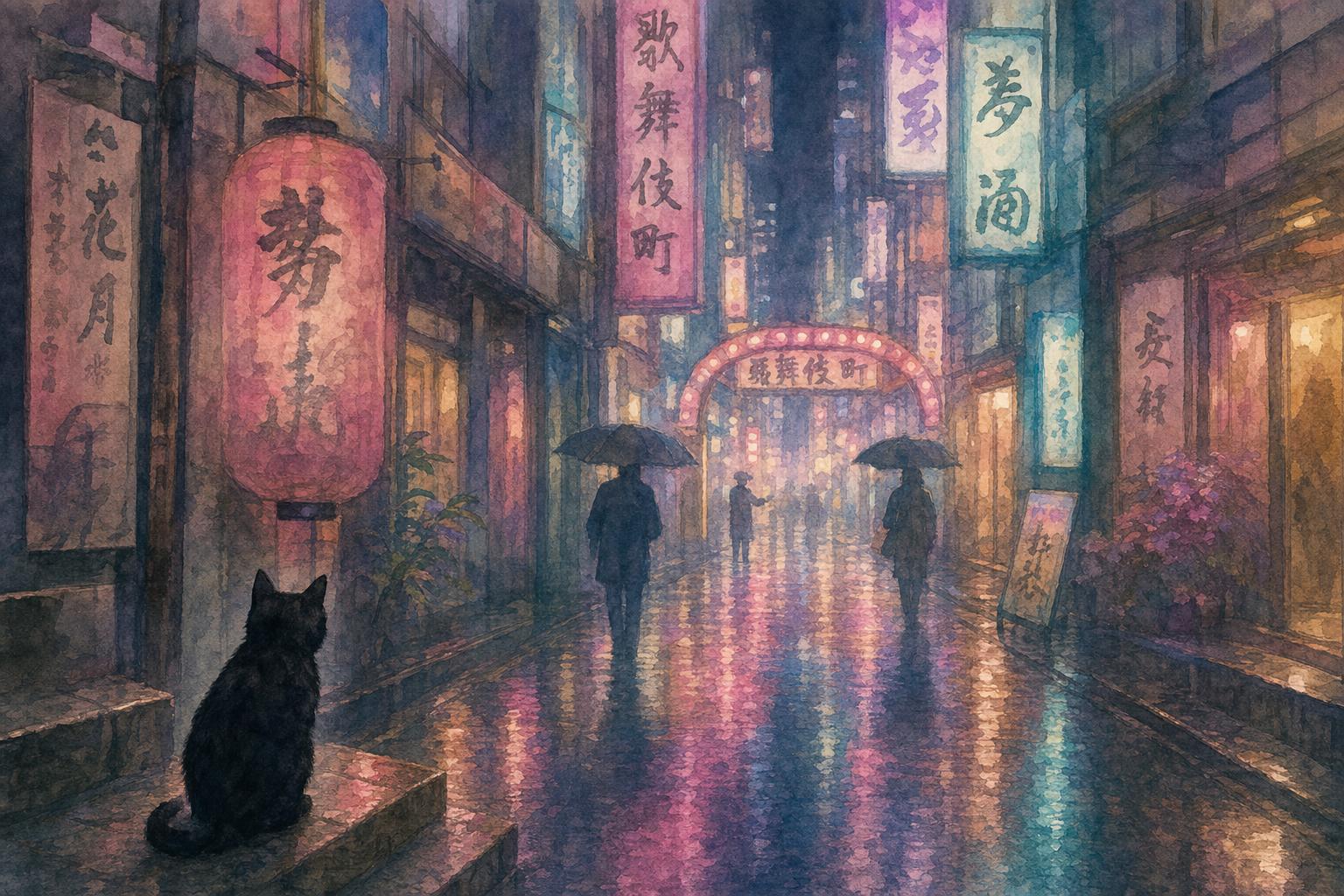
Behind the polished storefronts, there’s a patch of pavement that tells the truth more bluntly than all the rest. Along Ōkubo Park, a stone’s throw from Kabukichō, women stand waiting in the night, what Japanese calls the tachinbo. The street trade had almost disappeared, it has come back. In 2024, the police arrested 88 women for soliciting around this single park, nearly 80 percent of them in their twenties, most unemployed. And when you ask them why, the answer, for nearly half, comes down to one thing, paying off a host club. The loop closes, the club makes the debt, the street pays it back.
The foreign traveler is not a distant spectator of all this, he has become a participant. With the weak yen and the videos circulating on social media, clients now come from Korea, from China, from the West, sometimes in groups, negotiating a price typed out on a phone. The rates, which no official statistic measures, hover around 10,000 to 20,000 yen, hotel not included. The police noted a detail that chills the blood, some women deliberately targeted foreigners and elderly men, betting they would never go file a complaint. One network thus accumulated 110 million yen in two years. The phenomenon is swelling, the police recorded 75 arrests for soliciting around the park in the first half of 2025 alone, more than double the previous year, and the spot has become a “sex tourism” destination talked about on foreign social media. One woman who was arrested put it bluntly, “I could get more customers than at a shop, and 70 percent were foreigners.”
A young woman of twenty, who worked in a soapland to pay off and support a host, told her story in a Fuji TV documentary.
When I started selling my body, I cried every day. Sometimes I’d ask myself, why am I doing this, for this person?
I tell all of this for one reason only, so that people stop seeing an “exotic backdrop” where there are damaged lives. These women are not folklore, many are caught in debt, isolation, sometimes fleeing a family. Associations like Nihon Kakekomi-dera try to reach out to them, and it would be wrong to reduce them to nothing more than voiceless victims. But one thing is certain, there is nothing here to “visit.” Taking part as a tourist means adding your weight to a machine that grinds people down.
There is a dimension here that people prefer to leave unsaid. At the lowest prices, many of the workers are not Japanese, and the line with human trafficking grows blurry. Japan has long ranked among the destination countries for trafficking tracked in international reports. With no reliable figures on how much of it is coerced, basic caution is in order, paying at a discount means risking that your money feeds a network that exploits.
If you sleep with a Chinese prostitute, especially at the cheaper places, the chances are very high that she was trafficked. And even if she wasn’t, your money is very likely going to an organization that traffics.
The trap bars of Kabukichō (bottakuri)
Here it’s no longer a service, it’s a straight-up scam. In Kabukichō, touts, the kyakuhiki, lure you with a nomihodai at 2,000 yen, then the bill explodes in a bottakuri bar, up to 240,000 yen in the most violent cases. I laid out exactly how it happens, and how to avoid it, in the guide Sex in Japan.
Never follow a tout, and never enter a bar you were pulled into by the arm, however tempting the offer. It is, by far, the number one cause of disaster nights for travelers in Japan.
The line never to go near
A word without the slightest ambiguity. Anything involving minors, even remotely, is an extremely serious crime in Japan, heavily punished, and the gray area this whole article talks about does not apply to it in any way. The age of consent was raised to 16 in 2023, and paying for or soliciting anyone under 18 falls under a specific law, among the harshest in the country. You don’t go near it, you don’t joke about it, full stop.
And if you really want to meet someone?
The real way to meet people in Japan has nothing to do with a catalog. It goes through time and sharing, a language exchange on HelloTalk or in person, a neighborhood izakaya where you become a regular, a cooking or pottery workshop, a hiking club, a local matsuri. Learn three words of Japanese, download LINE, be curious and patient, and the doors open. It’s slow, it’s real, and that’s where the true tenderness of Japan lies. If you’re a couple, treat yourselves to a love hotel for the fun of the decor, it’s the only address on this page that I wholeheartedly recommend.
Frequently asked questions
Do soaplands accept foreigners?
Rarely. Most establishments, soaplands first among them, post a refusal of foreigners, out of concern for language and discretion. This is legal in Japan, where no general law forbids a private business from turning away a customer on that basis. A few rare addresses target this market, often with a surcharge, but that’s the exception.
What is the difference between a kyabakura and a soapland?
Everything. The kyabakura is a conversation club with no physical contact at all. The soapland is an establishment where sexual acts take place, behind the fiction of the “bath and massage.”
Is a host club prostitution?
No, you pay for company and drinks, with no contact. The problem isn’t the act, it’s the debt, the credit system that pushed so many young women toward prostitution that a 2025 law had to regulate it severely.
How much does it cost?
It varies enormously by format and district, and no official price exists. Above all, remember that the real bill is almost always higher than the advertised price, and that in the trap bars it has no limit at all.
Is it dangerous?
It can be, especially for a foreigner, between scams, card fraud, legal trouble and the presence of organized crime. Not to mention the health risk, which this gray area never guarantees, against a backdrop of a syphilis surge across the country.
For the full cultural and legal context, read our guide Sex in Japan. And to plan a beautiful trip, our Japan FAQ.